Artificial Intelligence
Should This Process Even Be Automated?
Technical feasibility and business justification are different tests. Volume, stability, error tolerance, data quality, customer expectations and regulatory exposure all change the answer.
Article · September 18, 2026 · Comdatus Consulting · 6 min read
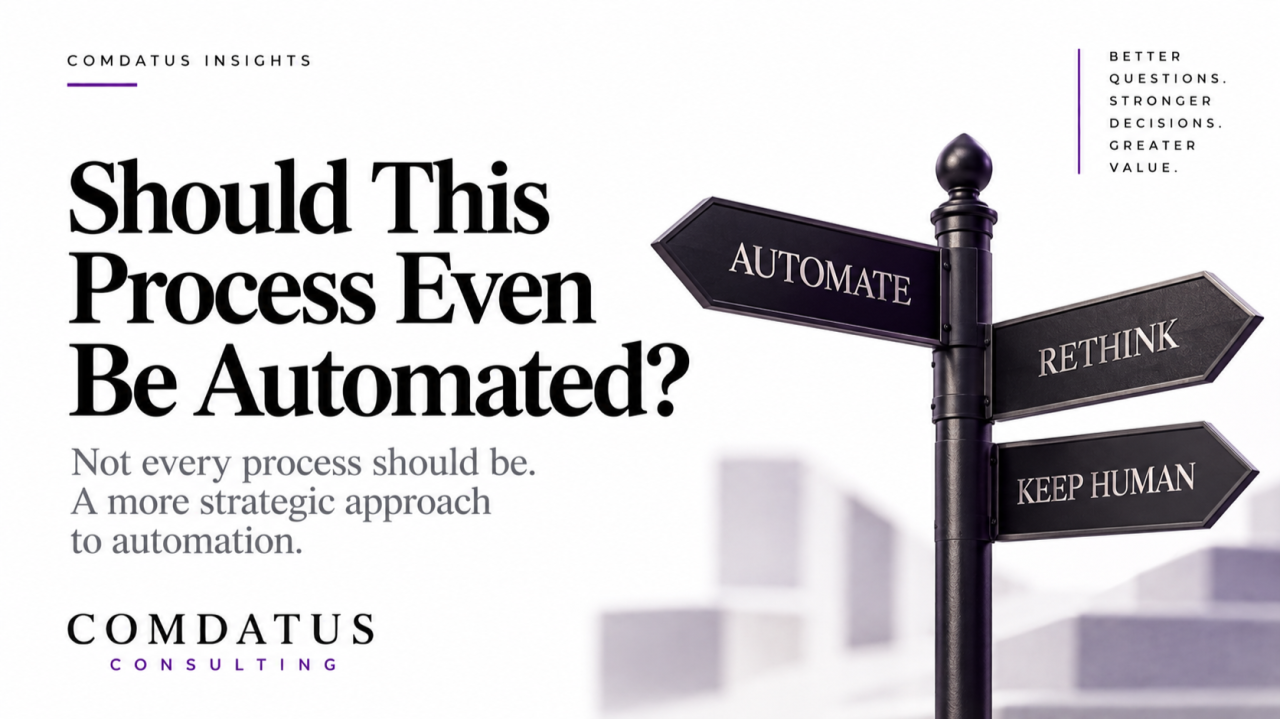
The most expensive question in automation is sometimes the one companies forget to ask: Should we automate this?
Technical teams naturally ask whether automation is possible. Executives need a higher standard. Does automating this process improve the business enough to justify the cost and risk?
Those are different questions.
Automation begins with process economics
Consider two activities.
Process A occurs 300,000 times per year, consumes four minutes each time, follows predictable rules, has clear inputs, and creates little value from human involvement.
Process B occurs 40 times per year, involves major customers, requires negotiation, has substantial financial consequences, and depends heavily on judgment.
AI may technically assist both. The first presents a much stronger case for automation.
Volume matters because fixed implementation costs can be spread over more transactions. If an automation costs $200,000 to implement, saving $1 on 5,000 annual transactions creates only $5,000 of yearly theoretical benefit. Saving $1 on two million transactions creates $2 million.
The mathematics often tells management where to look first.
Repetition and stability matter
Stable processes are easier to automate. If employees perform the same steps repeatedly, management can describe inputs, rules, exceptions, outputs, and success criteria.
Now consider a process that changes weekly because the business itself has not decided how it should operate. Automating it can lock instability into software. The company may spend the next year modifying its automation every time operations change.
Before using AI to automate a process, determine whether the process is mature enough to automate.
Error tolerance may be more important than productivity
Suppose an AI system is 98% accurate. That number sounds excellent. Whether it is acceptable depends entirely on what the remaining 2% means.
A 2% error rate in internal meeting summaries may be manageable. A 2% error rate in a payment workflow could be disastrous.
AI performance must therefore be evaluated against the cost of an error, not against an abstract accuracy standard. NIST's AI Risk Management Framework recommends analyzing expected benefits and costs, defining human oversight, measuring performance, and determining whether residual risk remains within organizational tolerance.
Customer sensitivity changes the answer
Some interactions exist because customers want convenience. Others exist because customers want a person.
A pharmacy customer asking when the store closes probably does not need a human. A grieving family discussing a complicated claim may. A wealthy client making a consequential investment decision may value an adviser precisely because the adviser accepts professional responsibility for judgment.
Automating an interaction whose value comes from human judgment can destroy the feature the customer was purchasing.
Executives should therefore ask: Why does the customer use this channel today? Is human interaction a cost? Or is it part of the product?
Regulatory and legal risk
Processes involving employment, credit, insurance, healthcare, financial services, biometrics, children, sensitive personal data, or safety may justify a higher automation threshold.
This does not mean AI cannot be used. It means the cost of governance, validation, documentation, and human oversight should be included before management declares the process attractive.
The EU AI Act, for example, uses a risk-based structure and imposes different obligations depending on the system and use case. Significant provisions are now applicable, while some requirements for high-risk systems phase in later.
Does the data exist?
Automation cannot reliably reason over information the company does not possess.
Imagine management wants AI to prioritize sales opportunities based on why customers buy. But salespeople have never recorded the information consistently. The CRM contains missing fields, outdated contacts, inconsistent stages, duplicate accounts, and subjective notes.
The AI problem is downstream. The data problem is upstream. The organization may need to fix its sales process before building predictive intelligence on top of it.
How much judgment does the task actually require?
Jobs that appear repetitive from a distance often contain hidden judgment.
An experienced employee may know which customers require special handling, which supplier delays are harmless, which unusual transaction looks suspicious, when a policy exception is appropriate, or which data point is unreliable.
Management only discovers that tacit knowledge when automation encounters an exception. Process discovery should therefore involve the employees who actually perform the work, not merely the manager who receives the final report.
A practical Comdatus Process Automation Screen
For initial evaluation, score each category from 0 to 2. This is a management diagnostic, not a scientific model.
- Volume: 0 = low; 1 = moderate; 2 = high.
- Repetition: 0 = highly variable; 1 = partially repeatable; 2 = highly standardized.
- Process stability: 0 = frequently changing; 1 = evolving; 2 = stable.
- Data readiness: 0 = poor; 1 = usable with remediation; 2 = reliable and accessible.
- Measurability: 0 = subjective success; 1 = partially measurable; 2 = objective KPIs.
- Error tolerance: 0 = errors can cause major harm; 1 = errors are manageable with controls; 2 = low-consequence errors.
- Human judgment requirement: 0 = judgment is central; 1 = mixed; 2 = little judgment required.
- Customer sensitivity: 0 = human interaction is highly valued; 1 = mixed; 2 = customer prioritizes speed or convenience.
- Regulatory complexity: 0 = substantial; 1 = manageable; 2 = limited.
- Implementation difficulty: 0 = major integration effort; 1 = moderate; 2 = relatively straightforward.
- Economic impact: 0 = little financial value; 1 = moderate; 2 = significant.
- Reversibility: 0 = difficult to reverse; 1 = partially reversible; 2 = easily reversed.
A high score does not mean "automate automatically." It means the process deserves deeper investigation. A low score does not necessarily mean "never automate." It means the burden of proof should be higher.
Break processes into components
A common mistake is evaluating entire jobs.
Take recruiting. Recruiting includes writing job descriptions, sourcing, candidate communication, scheduling, resume review, interviews, candidate evaluation, negotiation, and final selection. These activities have very different risk and judgment profiles.
AI may be useful for scheduling and drafting communications even if management decides that consequential candidate decisions remain human-led.
The same decomposition works elsewhere. Accounts payable is not one task. Customer service is not one task. Marketing is not one task. Software development is not one task.
The HBS/BCG "jagged frontier" research reinforces this point: AI can produce large gains on some tasks while hurting performance on other, superficially similar tasks.
Full automation is not the only outcome
Executives often think in two states: human and automated. There is a large territory between them.
AI-assisted: the employee remains responsible and uses AI for drafts, retrieval, or analysis.
Human approval: AI prepares an action; a person authorizes it.
Exception-based automation: AI handles predictable cases while humans manage unusual ones.
Autonomous: the system performs the task without routine human approval.
The correct level may change over time. A company can begin with assistance, collect evidence, then automate only where performance justifies it. That sequence limits downside while still allowing innovation.
The final test
Before automating, management should be able to complete this sentence: We are automating ______ because it currently costs or limits ______, and we expect the new process to improve ______ by approximately ______ without increasing ______ beyond our tolerance.
If the blanks cannot be filled, the company probably does not yet have an automation case. It has an automation idea. Those are not the same thing.
Comdatus Consulting perspective: The question is never merely whether AI can automate a process. The decision should depend on transaction economics, stability, judgment, error consequences, customer expectations, data quality, risk, and reversibility.
This article also appears on LinkedIn.
Related insights
Artificial Intelligence
The Human Cost of Bad AI Implementation
Staff do not read the strategy, they feel the change in their job. Uncertainty alters behaviour long before automation alters headcount, and badly handled it destroys the adoption the programme depends on.
Article · September 23, 2026 · 6 min read
Artificial Intelligence
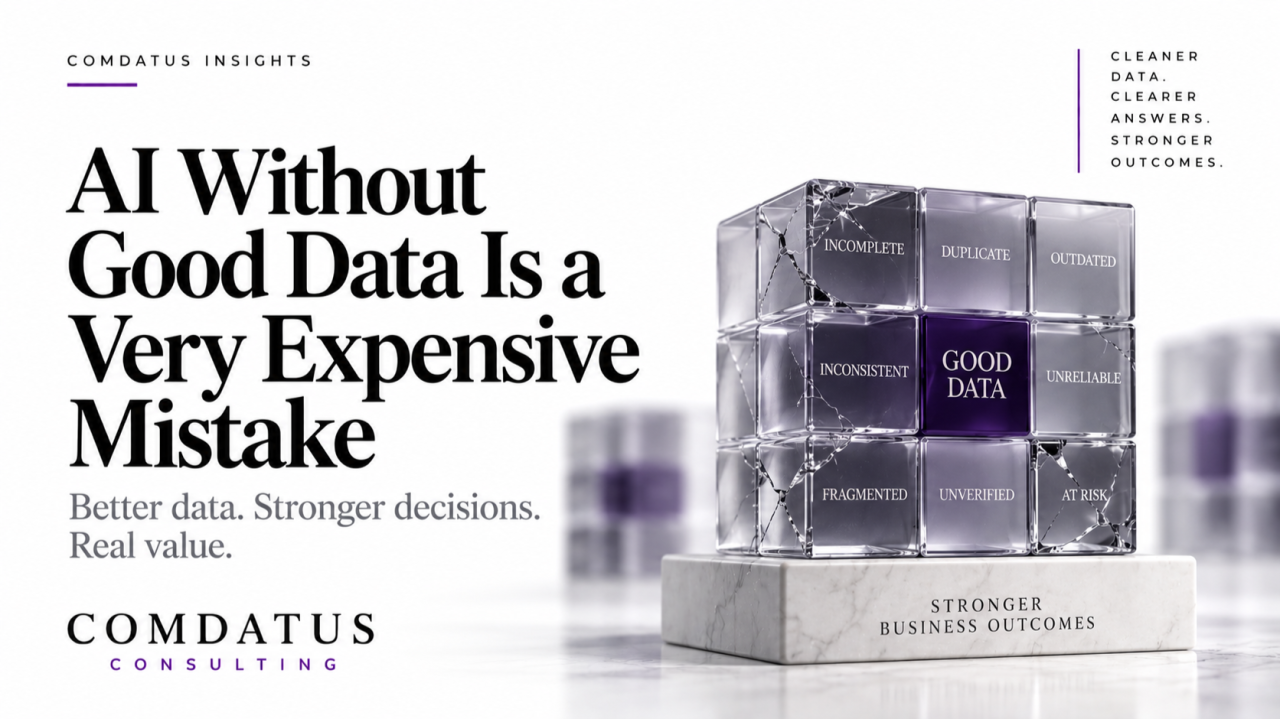
AI Without Good Data Is a Very Expensive Mistake
The best model in the world reasoning over unreliable information still produces unreliable answers. Fragmentation, duplicates and permissions decide feasibility long before the model does.
Article · September 22, 2026 · 6 min read
Artificial Intelligence
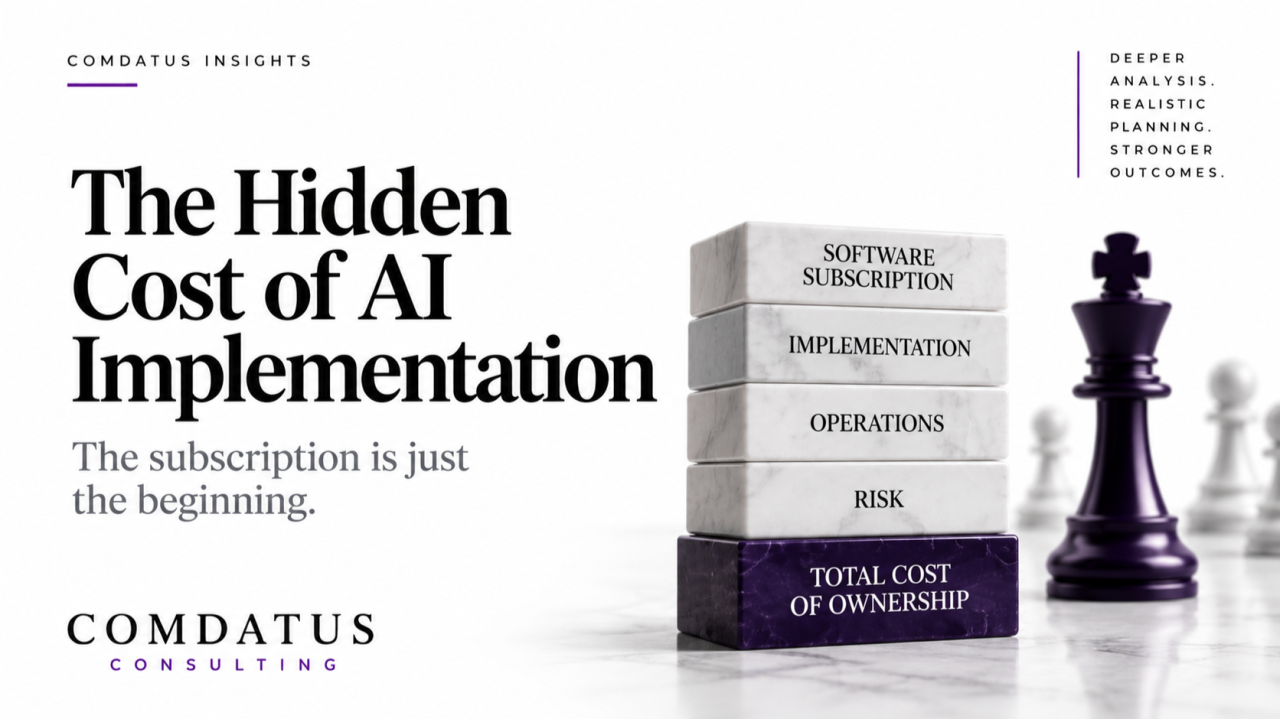
The Hidden Cost of AI Implementation
The subscription is the cheapest part. Data preparation, integration, oversight, change management and security are where the real cost of AI sits.
Article · September 18, 2026 · 6 min read