Artificial Intelligence
The Human Cost of Bad AI Implementation
Staff do not read the strategy, they feel the change in their job. Uncertainty alters behaviour long before automation alters headcount, and badly handled it destroys the adoption the programme depends on.
Article · September 23, 2026 · Comdatus Consulting · 6 min read
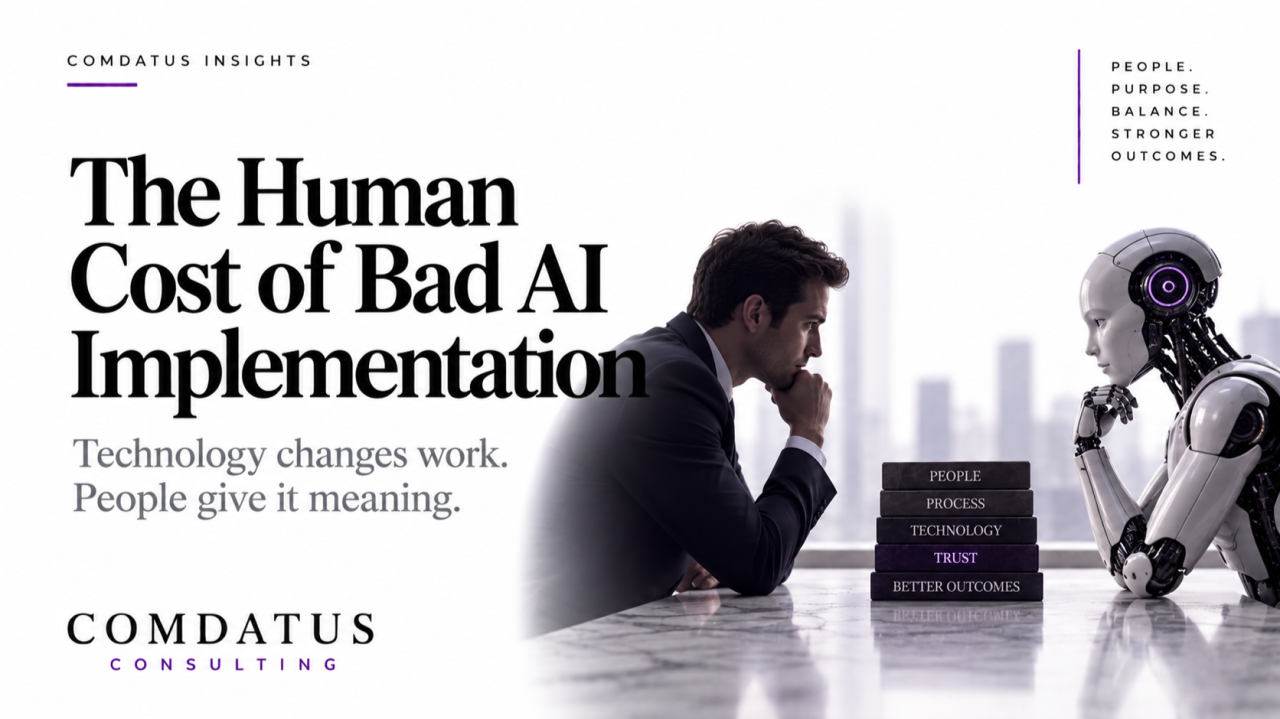
Employees rarely experience AI strategy as a strategy document. They experience it as a change in their job.
A task disappears. A new tool becomes mandatory. Management announces a productivity target. A workflow changes. Someone hears that the company wants to "do more with fewer people." Employees begin wondering which part of the sentence refers to them.
That makes workforce design central to AI implementation. Not secondary.
Uncertainty changes behavior before automation changes jobs
When employees believe AI may threaten their roles, some predictable reactions appear. They may resist the system. They may hide inefficiencies that could attract automation. They may avoid sharing expertise. They may use AI secretly to keep pace. They may overstate what the technology can do because management rewards enthusiasm. Or they may reject useful tools because the implementation has become associated with workforce reduction.
None of those outcomes helps the business.
Management should therefore be specific about what is changing. Which tasks? Which metrics? Which responsibilities remain human? Which new skills are required? How will performance be evaluated?
Ambiguity creates its own operational cost.
AI affects workers differently
The NBER customer-service study provides an important example. Average productivity increased 14%, but the benefits were not evenly distributed. Less-experienced and lower-skilled workers improved substantially more than experienced, highly skilled employees. Researchers suggested the tool helped transmit practices used by stronger workers to people earlier in the learning curve.
That has major organizational implications. AI may compress some experience advantages. It may help new employees become productive more quickly. It may also change what senior employees are valuable for.
If AI can distribute routine expertise, experienced workers may become more important in complex cases, judgment, quality control, training, client relationships, system supervision, and process improvement.
The correct question may not be "How many people can AI replace?" It may be "How should work be redesigned around what people and AI each do well?"
Productivity targets can destroy adoption
Suppose an executive tells employees: "AI should make everyone 30% more productive." Where did 30% come from? Perhaps from a study involving a different job. Perhaps a vendor presentation. Perhaps a benchmark.
Now employees are expected to hit a number that was never validated in their workflow. This creates pressure to use AI where it does not help, accept low-quality output, under-review work, or manufacture productivity claims.
The organization then loses the information it needs to evaluate AI objectively. Pilot first. Measure. Set expectations from evidence.
Shadow AI grows when governance trails behavior
Employees often adopt useful technology before companies establish policies.
IBM's 2025 breach research found that 63% of the breached organizations it studied lacked AI-governance policies. The report also highlighted security incidents associated with shadow AI.
Blocking every tool is rarely sufficient. Employees need to know which systems are approved, what data is prohibited, which tasks AI may assist, how outputs should be reviewed, and where to request new capabilities.
A workable governance system should make the safe path easier than the unsafe one.
Poor training produces false confidence
AI literacy is not prompt tricks.
Employees need to understand why AI can generate incorrect information, why confidential information matters, how source verification works, when outputs require expert review, what actions the system can perform, and where accountability sits.
A five-minute orientation explaining where to click is not training. A capable user should understand the boundaries of the tool.
This is especially important because natural-language interfaces make complex systems feel deceptively simple.
Do not remove expertise before the system is proven
Organizations sometimes see automation potential and reduce staffing before the new workflow has demonstrated stability. That reverses the proper sequence.
A safer sequence is: understand the process, pilot, measure, stabilize, document, cross-train, then redesign capacity.
If staffing changes occur first, employees may be forced to depend on a system that is still being debugged. That can convert an implementation problem into a business-continuity problem.
Employee involvement improves process discovery
The people closest to a workflow often know why apparently inefficient steps exist.
An executive sees "manual review." An employee sees "the point where we catch supplier mistakes." An executive sees "duplicate spreadsheet." The employee explains, "the main system does not capture the field the regulator asks for." An executive sees "three emails." The employee explains, "that is how we confirm approval because the application does not record it correctly."
This does not mean the existing process should remain unchanged. It means implementation teams should understand the real process before automating the process diagram.
McKinsey's research on AI-related change management emphasizes employee involvement and redesigning work rather than merely deploying tools.
The loss-of-learning problem
AI can remove repetitive work. Often that is good. But some repetitive work is also how employees learn.
Junior professionals develop intuition by reviewing documents, writing drafts, working through calculations, debugging code, handling routine cases, and seeing the consequences.
If AI performs all entry-level work, companies may eventually face a pipeline problem. Where do future experts come from?
The answer is not preserving inefficient work for its own sake. Organizations may need to redesign apprenticeship deliberately. Junior employees can review AI output, solve selected problems without assistance, work on exceptions, and receive structured training that ensures knowledge is still developing.
Productivity today should not eliminate expertise tomorrow.
Humans should own the decisions that require human accountability
There is a temptation to keep a person nominally "in the loop" so management can say AI does not make the final decision. That person needs actual authority, information, competence, and time to disagree. Otherwise human oversight becomes ceremonial.
For high-consequence workflows, management should specify who owns the decision, what evidence they see, what AI contributed, how disagreement is recorded, when escalation is required, and how system performance is audited.
Accountability should become clearer after AI implementation. Not more ambiguous.
Workforce reduction is not the only form of ROI
Stanford's 2026 AI Index reports that one-third of surveyed organizations expected AI to reduce workforce size over the following year, while nearly half expected little or no change. It also notes that large-scale employment effects remain uneven.
That matters because executives often equate automation ROI with layoffs.
Value can also appear through avoided hiring, higher throughput, faster response, lower overtime, reduced backlog, better quality, shorter training time, more customer coverage, or shifting employees toward higher-value activity.
The best outcome depends on the company. An organization growing 30% may use AI to expand without increasing headcount at the same rate. A mature operation may use AI to reduce cost. A professional-services company may use it to increase output per employee. A customer-facing business may reinvest capacity in better service.
The financial model should reflect the actual objective.
Good implementation creates a different conversation
Bad AI implementation says: "We bought AI. Use it."
Better implementation says: "This is the business problem. This is what we tested. Here is what the system performs well. Here are its limitations. These tasks will change. These decisions remain yours. These are the rules. Here is how we will measure the result. Here is how you report a problem."
That is not merely more considerate. It is better operating design.
AI adoption depends on employees behaving appropriately around systems whose output is not perfectly predictable. Trust cannot be demanded after deployment. It has to be earned through evidence, clarity, training, and accountability.
Comdatus Consulting perspective: Workforce impact should be analyzed before implementation, not after employees react. The objective is to design a human-AI operating model that captures economic value without inadvertently destroying expertise, trust, or critical controls.
Primary sources and research
- Brynjolfsson, Li & Raymond, Generative AI at Work
- IBM, Cost of a Data Breach Report 2025
- McKinsey, Reconfiguring Work: Change Management in the Age of Gen AI
- Stanford HAI, 2026 AI Index — Economy
This article also appears on LinkedIn.
Related insights
Artificial Intelligence
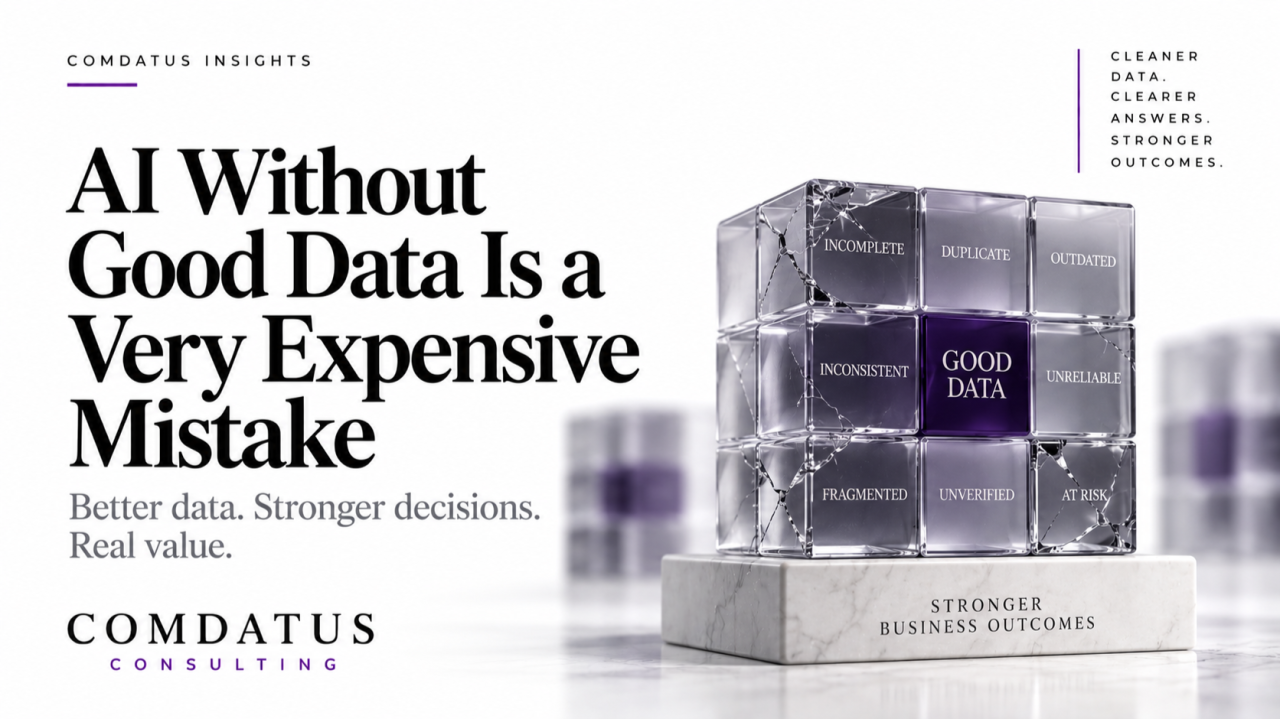
AI Without Good Data Is a Very Expensive Mistake
The best model in the world reasoning over unreliable information still produces unreliable answers. Fragmentation, duplicates and permissions decide feasibility long before the model does.
Article · September 22, 2026 · 6 min read
Artificial Intelligence
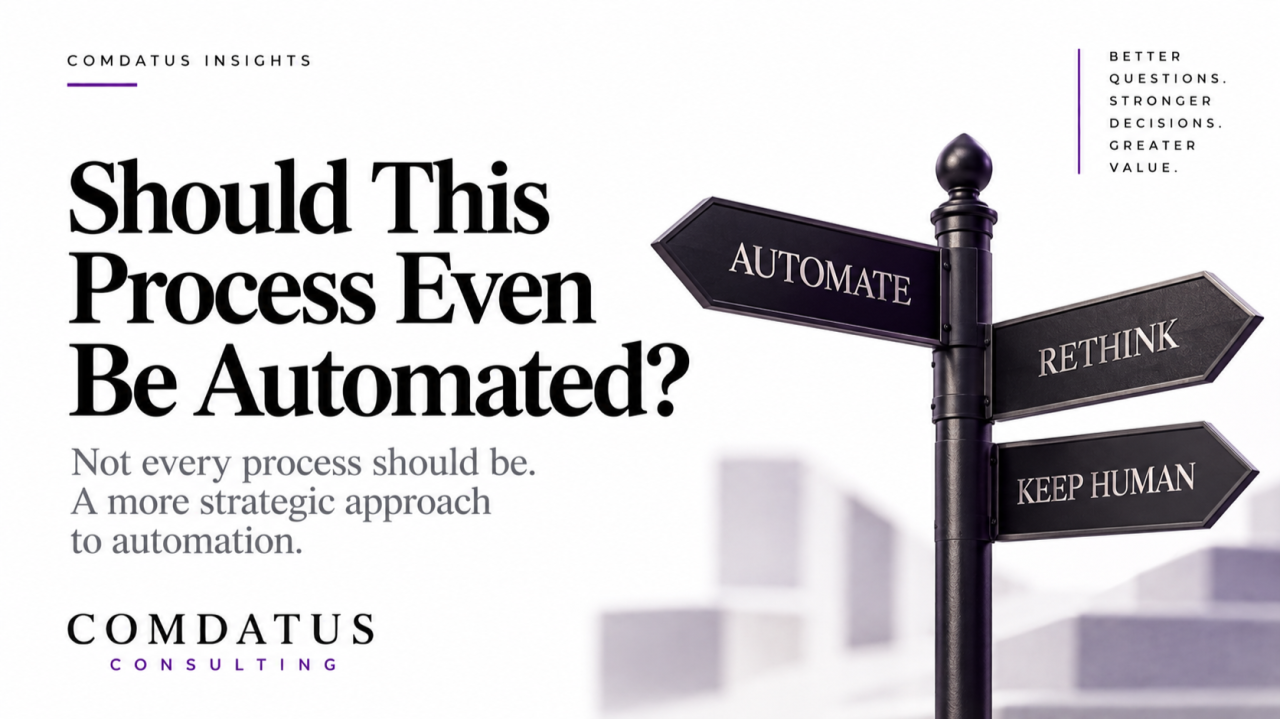
Should This Process Even Be Automated?
Technical feasibility and business justification are different tests. Volume, stability, error tolerance, data quality, customer expectations and regulatory exposure all change the answer.
Article · September 18, 2026 · 6 min read
Artificial Intelligence
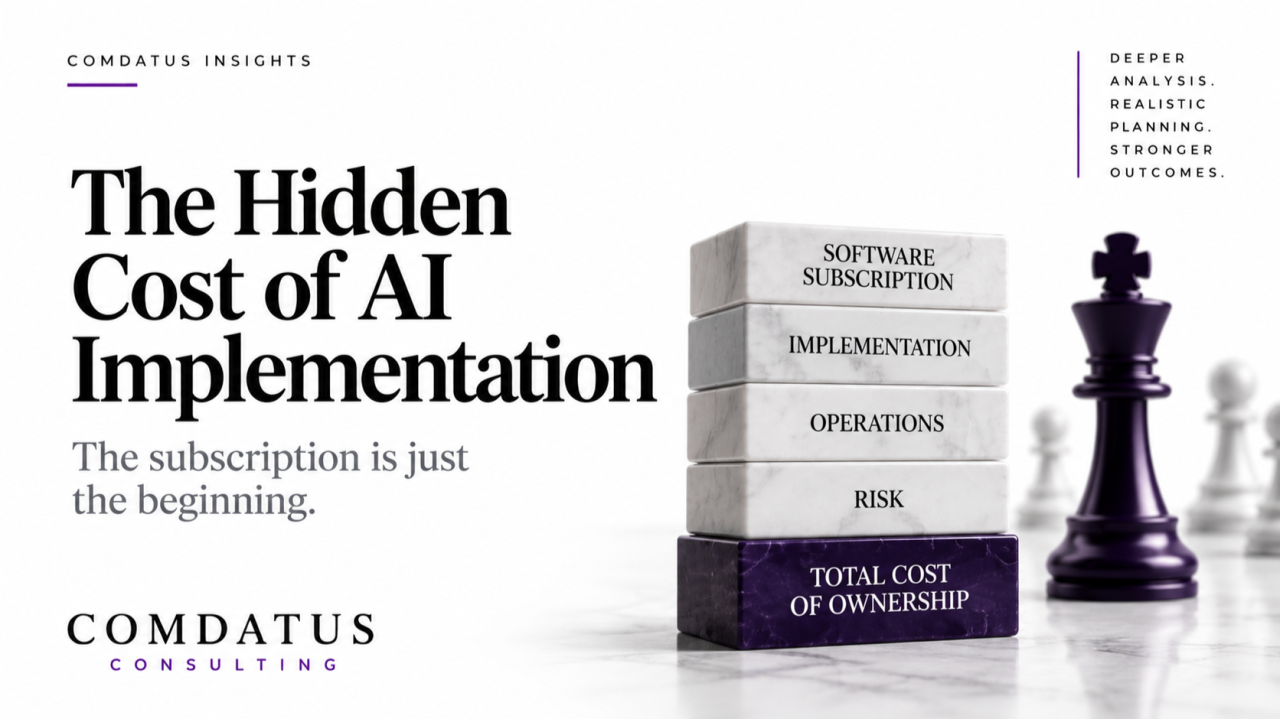
The Hidden Cost of AI Implementation
The subscription is the cheapest part. Data preparation, integration, oversight, change management and security are where the real cost of AI sits.
Article · September 18, 2026 · 6 min read