Artificial Intelligence
The Hidden Cost of AI Implementation
The subscription is the cheapest part. Data preparation, integration, oversight, change management and security are where the real cost of AI sits.
Article · September 18, 2026 · Comdatus Consulting · 6 min read
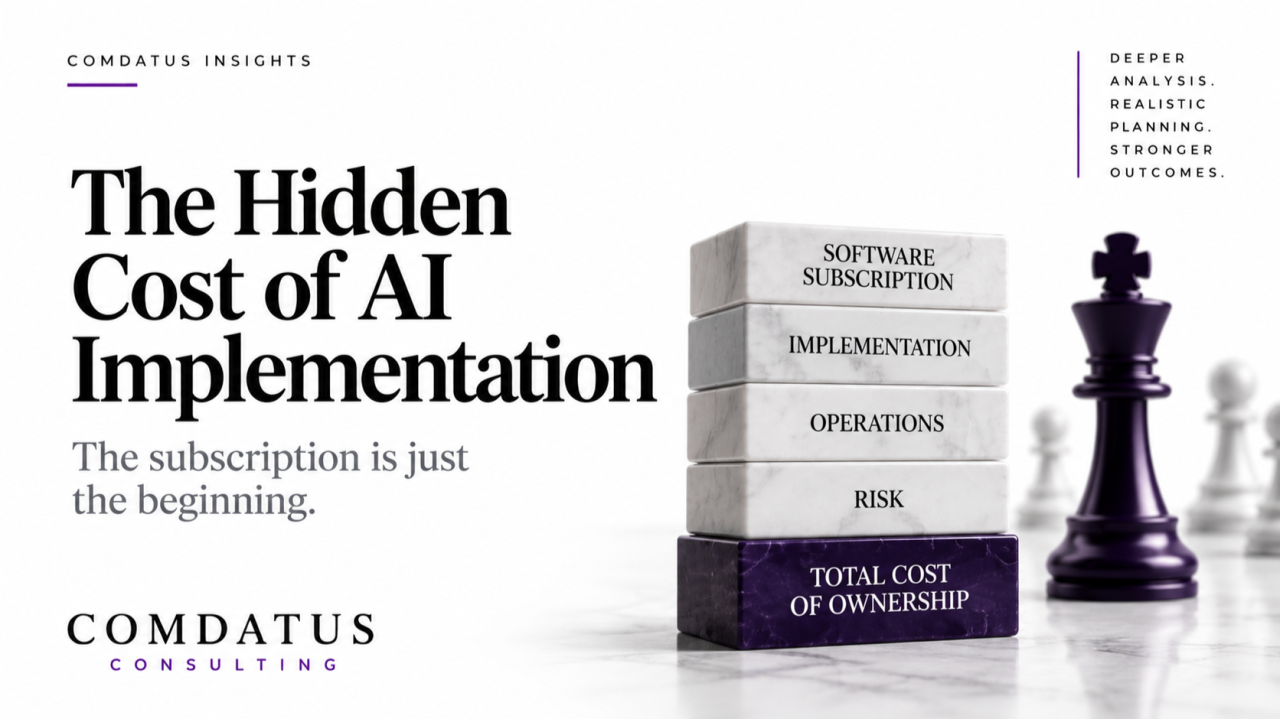
The easiest AI cost to calculate is usually the least interesting one: the software subscription.
An executive sees a price of $30, $50, or $100 per user per month and multiplies it by the workforce. The result looks manageable.
Then implementation begins. Data must be cleaned. Systems must be connected. Permissions must be redesigned. Employees must be trained. Security reviews appear. Consultants or engineers are needed. Usage grows. API bills increase. New monitoring tools are introduced. Models change. Workflows need maintenance. Employees discover edge cases. Legal reviews new use cases.
Suddenly, the license was only the admission price.
AI should be evaluated using total cost of ownership
A serious business case should separate at least four categories.
Acquisition cost includes software subscriptions, platform fees, model access, API usage, and infrastructure.
Implementation cost includes integration, development, data preparation, process redesign, testing, consulting, configuration, and project management.
Operating cost includes monitoring, support, model usage, human review, cybersecurity, vendor management, retraining, and continuous improvement.
Risk-adjusted cost includes expected losses associated with errors, downtime, security incidents, compliance problems, customer impact, or failed implementation.
These costs do not appear equally in every project. That is precisely why a generic "How much does AI cost?" estimate is usually not useful.
Data preparation can cost more than the AI layer
Imagine a manufacturer wants an AI assistant capable of answering technical questions about equipment. The apparent project is straightforward: buy model access, connect internal documents, build an interface.
But the documentation exists across twenty years. Several versions of the same manual exist. Some PDFs are scanned. Naming conventions changed. Parts were discontinued. Engineers keep unofficial troubleshooting notes. Access rights vary by department. Some documents contain customer information.
Before the model can answer reliably, the organization may need a knowledge-management project. That work would have value even without AI. But it remains part of the implementation cost if AI depends on it.
RAND's research into AI project failures identified inadequate data as a leading problem reported by practitioners.
Integration cost grows with ambition
Giving employees access to a general-purpose assistant is relatively simple. Allowing AI to act across enterprise systems is not.
The company may need identity management, role-based permissions, API integrations, data pipelines, logging, audit trails, exception handling, approval workflows, sandbox environments, monitoring, and rollback mechanisms.
The more consequential the action, the stronger those controls generally need to become. This is why the cost curve changes dramatically when an AI system moves from "draft an email" to "read the customer account and issue the refund."
Human oversight is an operating cost
Some AI business cases quietly assume that human review will make the system safe. Then they remove the cost of that human review from the ROI calculation. Both cannot be true.
If a qualified employee must review every output, the cost belongs in the model.
Suppose AI cuts document-processing time from ten minutes to two minutes. That sounds like an 80% reduction. But if an employee must spend another three minutes validating the output, the net process time is five minutes. The theoretical 80% improvement becomes 50%. If exceptions require senior specialists, savings may decline further.
That does not make the project unattractive. It makes the business case accurate.
Change management is implementation work
Technology does not produce value merely because it is available. People must use it correctly.
Employees need to understand what the system can do, what it cannot do, which information may be entered, when human review is required, where outputs should be documented, how problems are reported, and who remains accountable.
McKinsey's research on generative-AI transformation emphasizes workflow redesign and change management rather than tool deployment alone. In its 2025 survey, workflow redesign had the strongest relationship among the attributes tested with reported EBIT impact from generative AI.
Training is therefore not an optional "soft" cost. It is part of the mechanism through which ROI is created.
AI introduces variable costs
Traditional software pricing often feels predictable. AI workloads can be different. Costs may vary with number of users, tokens processed, documents indexed, API calls, agent actions, model chosen, compute requirements, storage, and frequency of use.
A successful pilot can therefore increase operating cost substantially when scaled.
The CFO should model at least three utilization scenarios: expected, high adoption, and extreme usage. A system that appears inexpensive with 50 pilot users may look different when 5,000 employees use it continuously.
Cybersecurity belongs in the ROI model
AI can create new data flows and access paths. That means security review and controls have real costs.
IBM's 2025 Cost of a Data Breach research analyzed 600 breached organizations. Within that sample, 63% lacked AI-governance policies, and IBM reported that shadow-AI-related incidents could increase breach costs materially.
Those findings should not be translated into a universal expected loss for every AI project. They do demonstrate why governance and security cannot be assumed to cost zero.
Regulation can create continuing obligations
For organizations operating internationally, compliance requirements are becoming more concrete.
The EU AI Act now applies substantial obligations on a phased timeline. Certain transparency requirements became applicable on August 2, 2026, while portions of the high-risk-system requirements take effect later.
Depending on the application and jurisdiction, a company may need legal analysis, system documentation, risk classification, testing, disclosures, recordkeeping, vendor due diligence, and ongoing monitoring. Compliance is not merely a pre-launch activity.
Opportunity cost is often ignored
Suppose a company spends twelve months building an elaborate proprietary AI assistant. The project succeeds technically. But a commercial platform now offers 90% of the functionality for a fraction of the cost.
The company did not simply spend development money. It also consumed engineering capacity, executive attention, project-management resources, and time that could have been invested elsewhere.
Opportunity cost is difficult to put into an accounting system. It is still economically real.
Calculate ROI from captured value
A disciplined ROI calculation might begin with annual captured benefit minus annual operating cost, producing annual net benefit. Then compare that with initial implementation investment.
If a project costs $600,000 to implement and creates $300,000 of recurring annual net benefit, a simplified payback period is two years.
But the calculation should be challenged. What percentage of projected labor savings actually becomes economic value? Are employees eliminated, redeployed, or simply less busy? Is the revenue increase incremental? Would some of it have occurred anyway? How much performance degradation should be expected? What happens if API costs double? How much internal support is necessary?
The strongest investment cases remain attractive after conservative assumptions.
Scenario analysis is better than false precision
Executives should avoid a single ROI estimate. Use three scenarios.
Downside: implementation costs exceed plan, adoption is weak, benefits are modest.
Base case: reasonable adoption and validated performance.
Upside: strong utilization and meaningful process redesign.
If the investment only makes sense under the upside case, management is making a speculative bet. That might be appropriate. It should be described accurately.
Include the cost of failure
Gartner's January 2026 analysis reported that at least half of generative-AI projects had been abandoned after proof of concept and cited data quality, risk controls, rising costs, and unclear business value among common causes.
An abandoned pilot is not always a failure. A $50,000 pilot that proves a $5 million rollout should not occur may have created tremendous value.
The more dangerous project is the one that scales before those weaknesses are discovered. That is why pilot cost should be seen partly as the price of information. A well-designed experiment buys evidence.
AI economics should survive without hype
The final business case should be understandable without technical language.
We spend X. The process currently costs Y. We expect to improve it by Z. Here is the evidence. Here are the implementation costs. Here are the ongoing costs. Here are the important risks. Here is the downside case. Here is how we will measure the result.
If the project cannot be explained that way, it probably is not ready for major capital.
Comdatus Consulting perspective: Before deciding whether an AI investment is attractive, organizations should calculate the full economic case — including integration, data, labor, change management, governance, security, monitoring, and failure risk — not merely the vendor price.
This article also appears on LinkedIn.
Related insights

Artificial Intelligence
The Human Cost of Bad AI Implementation
Staff do not read the strategy, they feel the change in their job. Uncertainty alters behaviour long before automation alters headcount, and badly handled it destroys the adoption the programme depends on.
Article · September 23, 2026 · 6 min read

Artificial Intelligence
AI Without Good Data Is a Very Expensive Mistake
The best model in the world reasoning over unreliable information still produces unreliable answers. Fragmentation, duplicates and permissions decide feasibility long before the model does.
Article · September 22, 2026 · 6 min read
Artificial Intelligence
Should This Process Even Be Automated?
Technical feasibility and business justification are different tests. Volume, stability, error tolerance, data quality, customer expectations and regulatory exposure all change the answer.
Article · September 18, 2026 · 6 min read