Artificial Intelligence
The AI Gold Rush: Why Businesses Should Not Adopt AI Just Because Everyone Else Is
88% of organisations were using AI by 2025, yet Gartner found at least half of generative-AI projects abandoned after proof of concept. Adoption is not a strategy.
Article · September 16, 2026 · Comdatus Consulting · 7 min read

Artificial intelligence has crossed an important threshold in business. The question in many executive meetings is no longer whether AI deserves attention. It does. The more dangerous question is whether attention has quietly become obligation.
By 2025, 88% of organizations surveyed in data reported by Stanford's 2026 AI Index were using AI, and 70% were using generative AI in at least one business function. Corporate investment continues to rise. Competitors are announcing AI initiatives. Employees are experimenting with tools themselves. Boards are asking management teams what their AI plans are. Vendors are adding AI to products that previously worked perfectly well without it.
For an executive, doing nothing can therefore feel reckless.
But so can doing something for the wrong reason.
Gartner reported in January 2026 that at least half of generative-AI projects had been abandoned after proof of concept, citing poor data quality, inadequate risk controls, escalating costs, and unclear business value among the causes.
Those two facts belong together.
AI adoption is widespread. AI success is not automatic.
Competitive pressure is real. That does not make every AI investment rational.
Business leaders are right to pay attention to technological transitions.
Companies that ignore meaningful technological change can lose productivity, customers, talent, distribution advantages, or entire markets. There are already business processes where AI can materially reduce processing time, increase capacity, improve analysis, or lower marginal cost.
The mistake is converting that observation into a much larger proposition: Our competitors are adopting AI; therefore, we need to adopt AI.
That skips the most important part of the investment decision. What business problem are we solving?
Suppose a company spends $500,000 implementing an AI platform because management believes competitors are "moving into AI." Six months later, employees have another interface to use, the company is paying additional software and consulting costs, IT is maintaining another integration, legal is reviewing new data risks, and managers have added an AI governance committee.
But nothing meaningful has changed. Customer acquisition has not improved. Operating costs have not declined. Employees are not producing materially more. Customers are not happier. Revenue has not increased.
The technology may work exactly as designed and still be a poor investment. A technically successful implementation can be a business failure.
AI FOMO changes how companies evaluate investments
Traditional capital investments usually face uncomfortable questions: What will this cost? What will it save? What revenue will it produce? How long until the investment pays back? What assumptions have to be true? What happens if those assumptions are wrong?
AI projects sometimes escape that discipline because management believes experimentation itself has strategic value. Sometimes it does. A limited experiment may be inexpensive and useful. Learning can be a legitimate objective.
But "we need to learn" and "we need to spend heavily" are not the same proposition.
Executives should distinguish among three categories of expenditure: exploration, small investments made to understand capabilities; piloting, controlled investments designed to determine whether a specific use case works economically and operationally; and scaling, material investment intended to change how the business operates.
Confusing those stages creates unnecessary risk. A $10,000 experiment does not require a perfect financial case. A $1 million production deployment should.
Vendors naturally begin with capabilities
Technology vendors are supposed to understand what their products can do. That is valuable. But the buying organization has a different responsibility.
The vendor asks: What can this technology automate? Management must ask: Should that process be automated at all?
A vendor may demonstrate that an AI assistant can handle customer questions. Management must determine whether its customers actually want that interaction, what percentage of questions the system can resolve correctly, what happens when it fails, whether the issue is sensitive, and how much the existing human interaction costs. Those are not software questions. They are business questions.
Consider two companies receiving 20,000 customer inquiries each month. Company A receives thousands of repetitive requests asking for shipping status, password resets, basic product specifications, and account information. The questions have objective answers. The company can easily route complicated issues to humans.
Company B provides private wealth advisory services. Clients often contact their adviser during consequential financial decisions precisely because they want contextual judgment, confidence, explanation, and accountability.
Both businesses technically could use AI customer service. Their business cases are completely different.
The hidden danger of undefined objectives
An AI initiative without a measurable objective can almost always be declared successful.
Employees used it. The pilot launched. The model generated answers. The demonstration impressed management. The company produced a press release.
None of those is necessarily economic value.
A better project begins with a baseline. For example: the accounts-payable department processes 18,000 invoices each month. Each invoice currently requires 5.5 minutes of employee handling. The error rate is 2.4%. The company spends $840,000 annually on the process. Its objective is to reduce handling time by 40% without increasing payment errors or weakening existing approval controls.
Now AI can be evaluated. The company knows what success means. Perhaps AI works. Perhaps traditional workflow automation works better. Perhaps the existing process simply needs redesign. Perhaps nothing should change. That is analysis.
Automation can make bad processes faster
One of the easiest mistakes in technology transformation is automating a process before asking why the process works the way it does.
Imagine a company requires employees to copy customer information manually from one system into another. Management could introduce AI to read the first system and populate the second. That might save time.
But why are there two systems requiring duplicated information in the first place? The better investment may be an integration between them. AI is not automatically the correct solution merely because AI can perform the task.
RAND researchers interviewing 65 experienced AI and machine-learning practitioners identified misunderstanding the underlying problem and focusing on new technology rather than the actual needs of users as major causes of AI-project failure. That is a management problem before it is a technology problem.
The AI readiness and opportunity assessment
Before a significant AI investment, executives should be able to answer five groups of questions.
Business value: What outcome are we trying to improve — revenue, margin, capacity, cycle time, accuracy, customer retention, or risk reduction? If the answer is simply "innovation," the project probably needs more definition.
Process suitability: Is the process repetitive? Is it stable? Are outputs objectively measurable? How costly are mistakes? Where is human judgment required? Can exceptions be routed safely?
Data readiness: Where does the necessary information live? Is it accurate? Can systems access it reliably? Do employees themselves trust the information? What permissions or privacy limitations apply?
Economic case: What is the current cost of the process? What implementation costs exist beyond the software subscription? What percentage of the theoretical productivity benefit will actually become cash savings, revenue, additional capacity, or improved service?
Risk: What happens when the AI is wrong? An error in an internal first draft is different from an error in a customer refund, medical recommendation, hiring decision, credit process, safety procedure, or regulatory filing.
Waiting is an investment decision too
There is an assumption that waiting means falling behind. Sometimes it does. Sometimes waiting six months means buying a substantially better product for less money after another company has paid to discover the implementation problems.
Technology capability is advancing rapidly. Stanford's 2026 AI Index documents significant year-over-year gains across several AI benchmarks and applications. That creates a strategic paradox: a company can suffer from moving too slowly, but it can also overpay for immature technology by moving too early.
A company should accelerate when the opportunity is material, its process is appropriate, the data and systems are sufficiently ready, risks can be controlled, and the economics justify action. It should wait when those conditions are absent.
The goal is not to become an "AI company." The goal is to become a better company. AI may be part of that. Sometimes it may be an important part. But the burden of proof should remain where it belongs: on the business case.
Comdatus Consulting perspective: Before a company commits significant capital to AI software, development, or automation, the first engagement should determine whether there is an investment worth making. Sometimes the answer will support substantial AI adoption. Sometimes it will identify one valuable workflow. Sometimes the financially responsible recommendation will be to wait.
Primary sources and research
- Stanford HAI, 2026 AI Index Report — Economy
- Gartner, Why 50% of GenAI Projects Fail — And How to Beat the Odds
- RAND, The Root Causes of Failure for Artificial Intelligence Projects and How They Can Succeed
This article also appears on LinkedIn.
Related insights
Artificial Intelligence
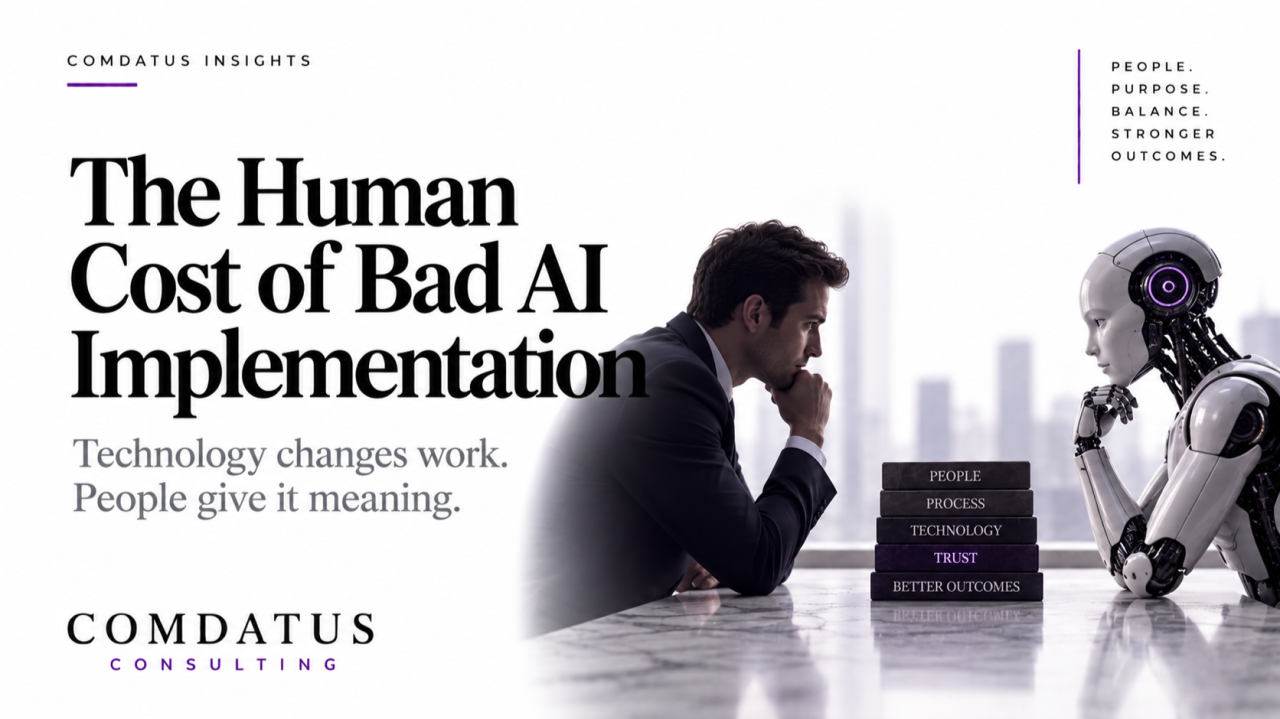
The Human Cost of Bad AI Implementation
Staff do not read the strategy, they feel the change in their job. Uncertainty alters behaviour long before automation alters headcount, and badly handled it destroys the adoption the programme depends on.
Article · September 23, 2026 · 6 min read
Artificial Intelligence
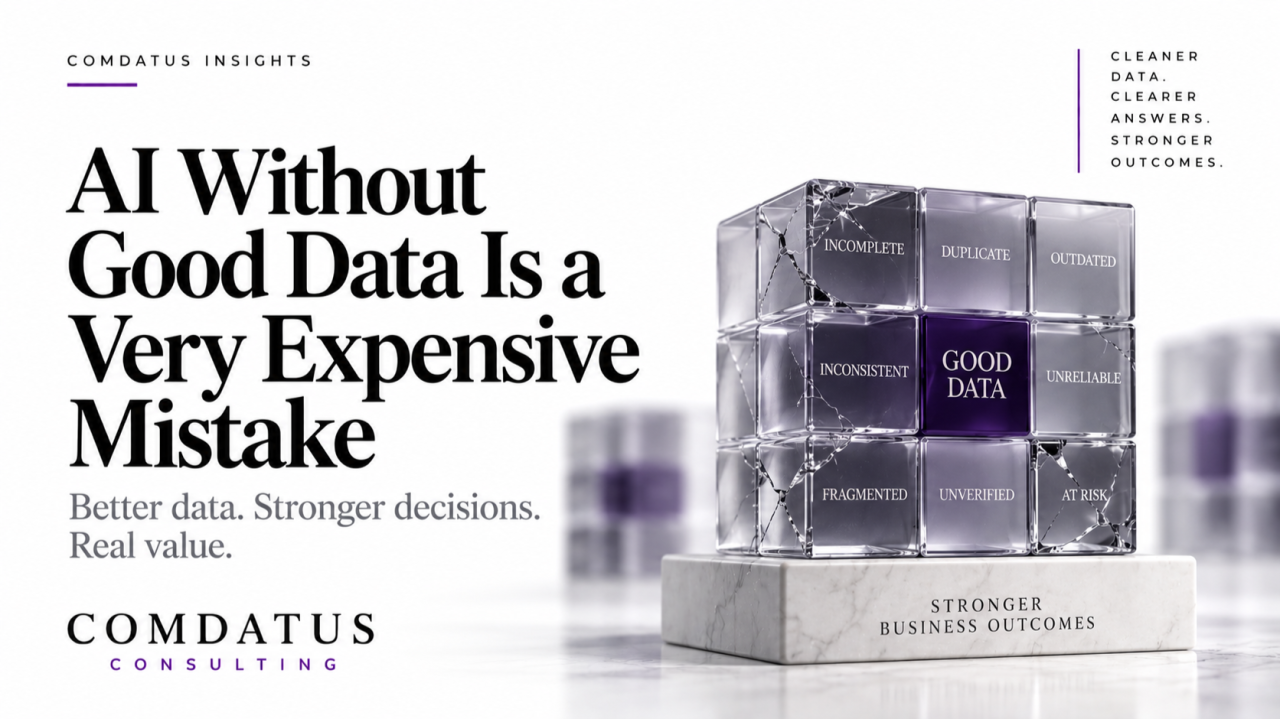
AI Without Good Data Is a Very Expensive Mistake
The best model in the world reasoning over unreliable information still produces unreliable answers. Fragmentation, duplicates and permissions decide feasibility long before the model does.
Article · September 22, 2026 · 6 min read
Artificial Intelligence
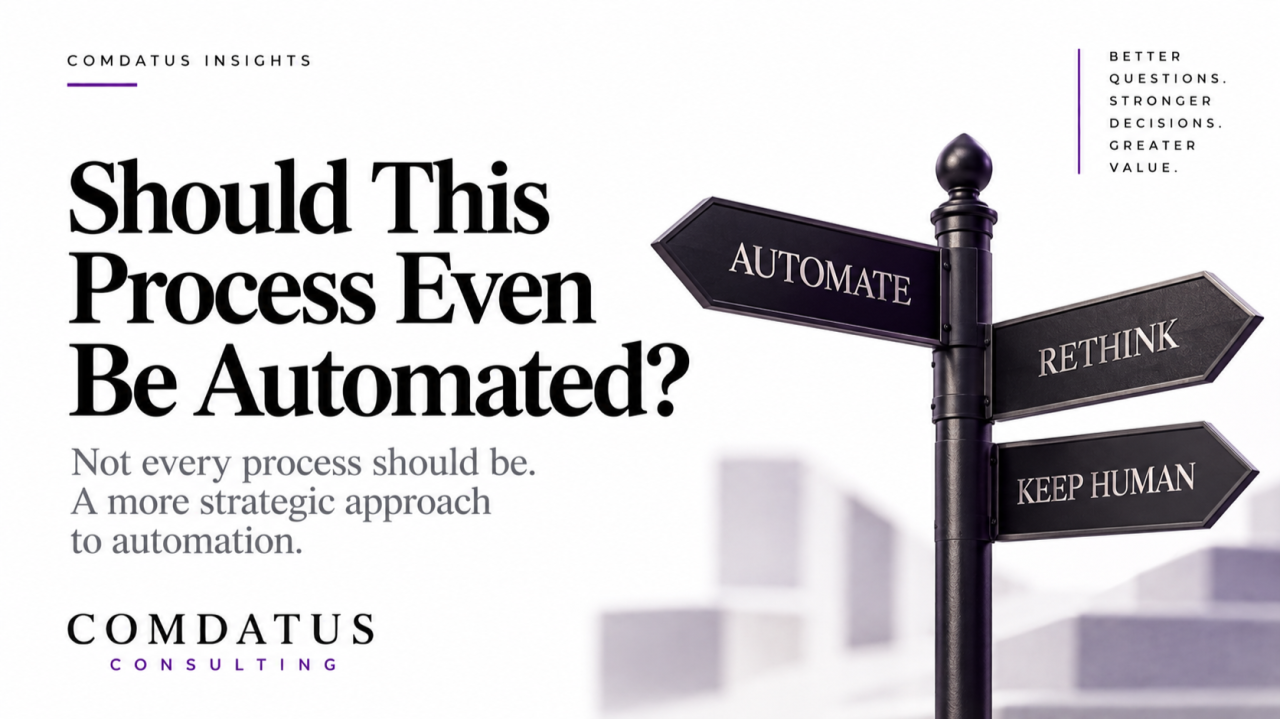
Should This Process Even Be Automated?
Technical feasibility and business justification are different tests. Volume, stability, error tolerance, data quality, customer expectations and regulatory exposure all change the answer.
Article · September 18, 2026 · 6 min read